During the Russian Civil War (1917-1922), the Aktobe region became one of the strategically important areas. One of the key military objectives was the struggle for control of the Orenburg-Tashkent Railway. To achieve this, the Aktobe Front was established to maintain the RSFSR's connection with Central Asia and prevent the Dutov forces from advancing southward. The operations of the Aktobe Front are divided into two stages: the first lasted from 3 July 1918 to 22 January 1919, and the second from 18 April to 13 September 1919.
In the summer of 1919, Aktobe came under the control of the White Army. One of the tragic events of that period, which later became the basis for the construction of this memorial, was the execution of several people. In her memoirs, local resident Yekaterina Potudina-Moshchenskaya recalls seeing a group of prisoners being escorted under armed guard toward the Ilek River. Shortly afterwards, gunshots were heard from the riverside. Her account is considered one of the historical testimonies that conveys the tragic atmosphere of those events.
The memorial was originally erected on the bank of the Ilek River. However, due to the river's annual spring flooding, the remains of those buried there were reinterred in Pushkin Park in 1945, and the monument was relocated to its present site.
Description of the Monument:
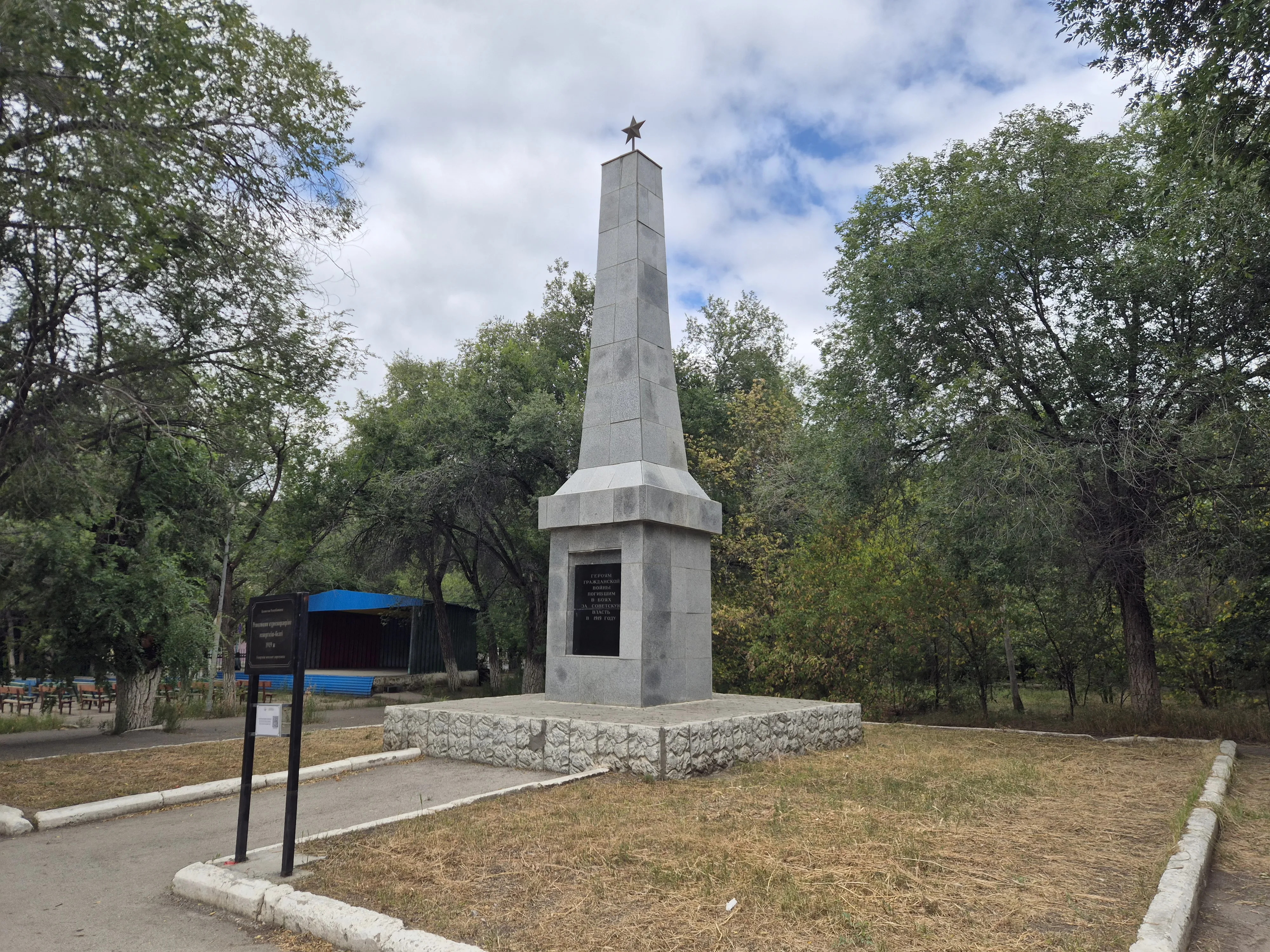
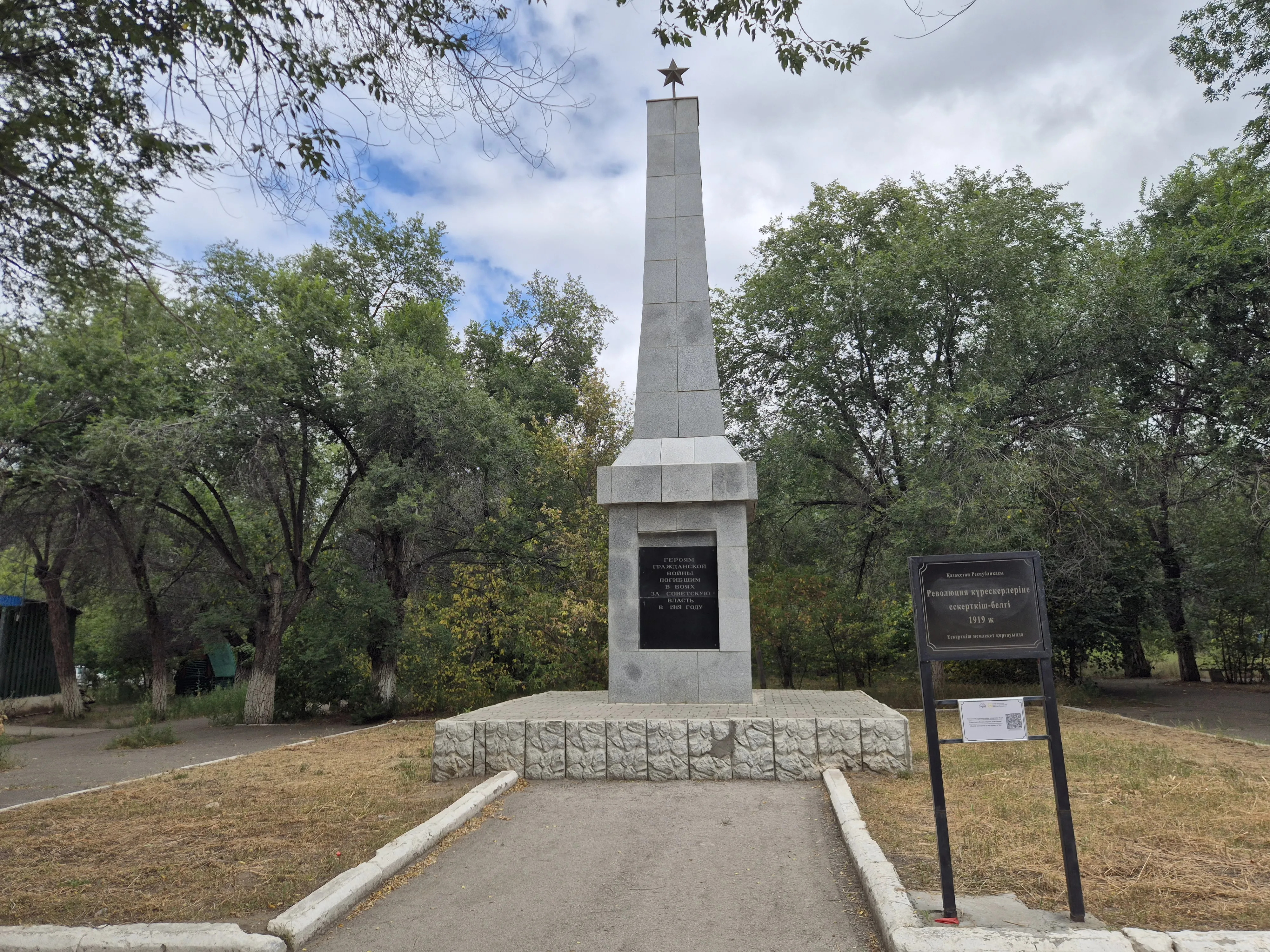
The monument is designed in the form of a memorial obelisk. It stands on a two-tiered stylobate and consists of a rectangular pedestal that gradually transitions into a pyramidal form. The obelisk is built of brick, faced with pink granite, and finished with marble slabs.
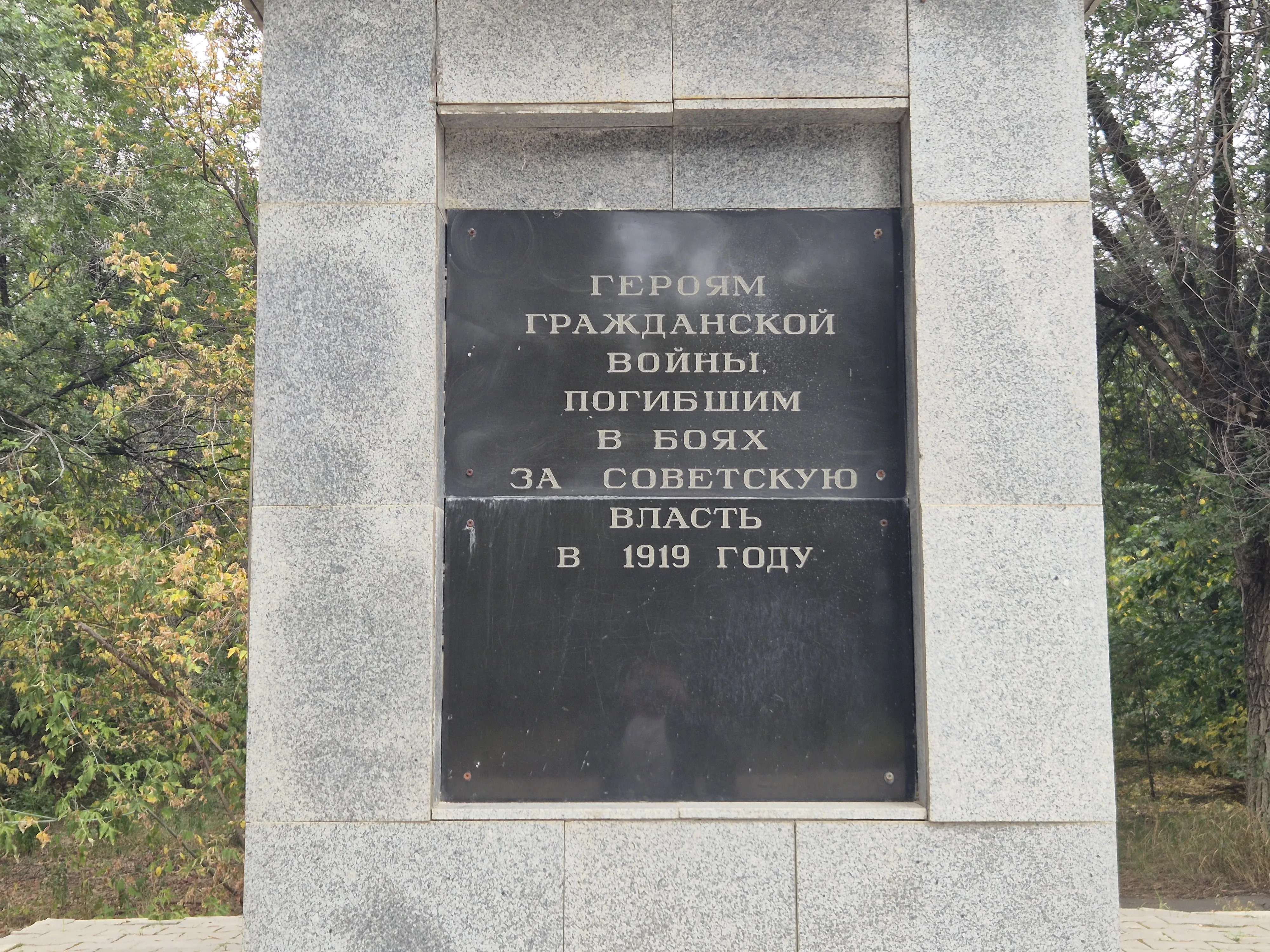
A memorial niche on the front of the pedestal bears the inscription: "To the Heroes of the Civil War who died in 1919 in the struggle for Soviet power." A five-pointed star crowns the top of the obelisk. The surrounding area is landscaped with U-shaped flower beds bordered by concrete blocks.
The obelisk is 5 metres high. The pedestal measures 1.5 × 1.5 metres at its base. Its lower section has a four-sided rectangular shape that gradually narrows into a four-sided trapezoidal form.
-
A. Pushkin Park